But how do AI videos actually work? | Guest video by @WelchLabsVideo
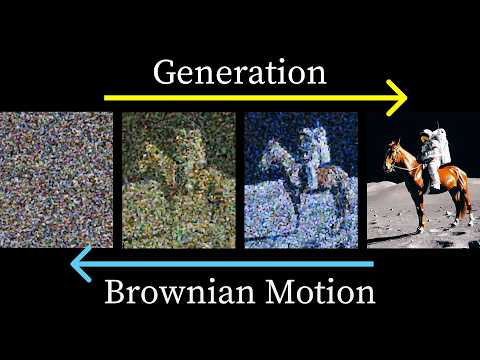
AI systems have advanced in generating videos from text prompts using diffusion models, which are deeply connected to physics and Brownian motion, enabling realistic video creation through iterative noise transformation and the integration of models like CLIP for enhanced image-video generation.
MAIN POINTS FROM TRANSCRIPT
- AI video generation uses diffusion models, akin to reverse Brownian motion, transforming noise into structured videos.
- Open source models like WAN 2.1 demonstrate text-to-video generation capabilities with iterative noise refinement.
- CLIP combines language and vision models, learning a shared space between words and images for enhanced AI creativity.
- Diffusion models, connected to physics, offer insights and speed improvements in image and video generation processes.
TAKEAWAYS
- Diffusion models transform random noise into realistic videos through iterative refinement, guided by text prompts.
- The connection to physics provides algorithms and intuitions for understanding and improving diffusion models.
- CLIP's shared representation space enhances the ability of AI to generate contextually accurate visuals from text.
- Advances in diffusion and language models highlight the importance of model size and dataset scale in AI capabilities.