Simulating Phase Change | Guest video by Vilas Winstein
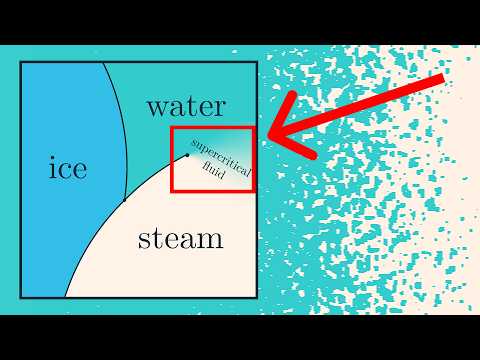
The video explores phase transitions through a simulation of a discretized fluid model called the liquid vapor model, using the Boltzmann formula to understand the behavior and parameters like temperature and chemical potential, while introducing the concept of equilibrium behavior in phase diagrams.
MAIN POINTS FROM TRANSCRIPT
- The video focuses on a simulation of the liquid vapor model to study phase transitions.
- Phase transitions involve changes in equilibrium behavior, not chemical reactions.
- The simulation uses temperature and chemical potential as key parameters.
- The video is part one of a two-part series, with the follow-up on the Spectral Collective channel.
TAKEAWAYS
- Phase transitions are discontinuities in equilibrium behavior determined by parameters like temperature and pressure.
- The liquid vapor model is a discretized representation of fluid behavior in phase transitions.
- Chemical potential is used instead of pressure in the simulation to manage molecule count.
- Understanding phase transitions requires knowledge of thermodynamic observables and their pairings.